

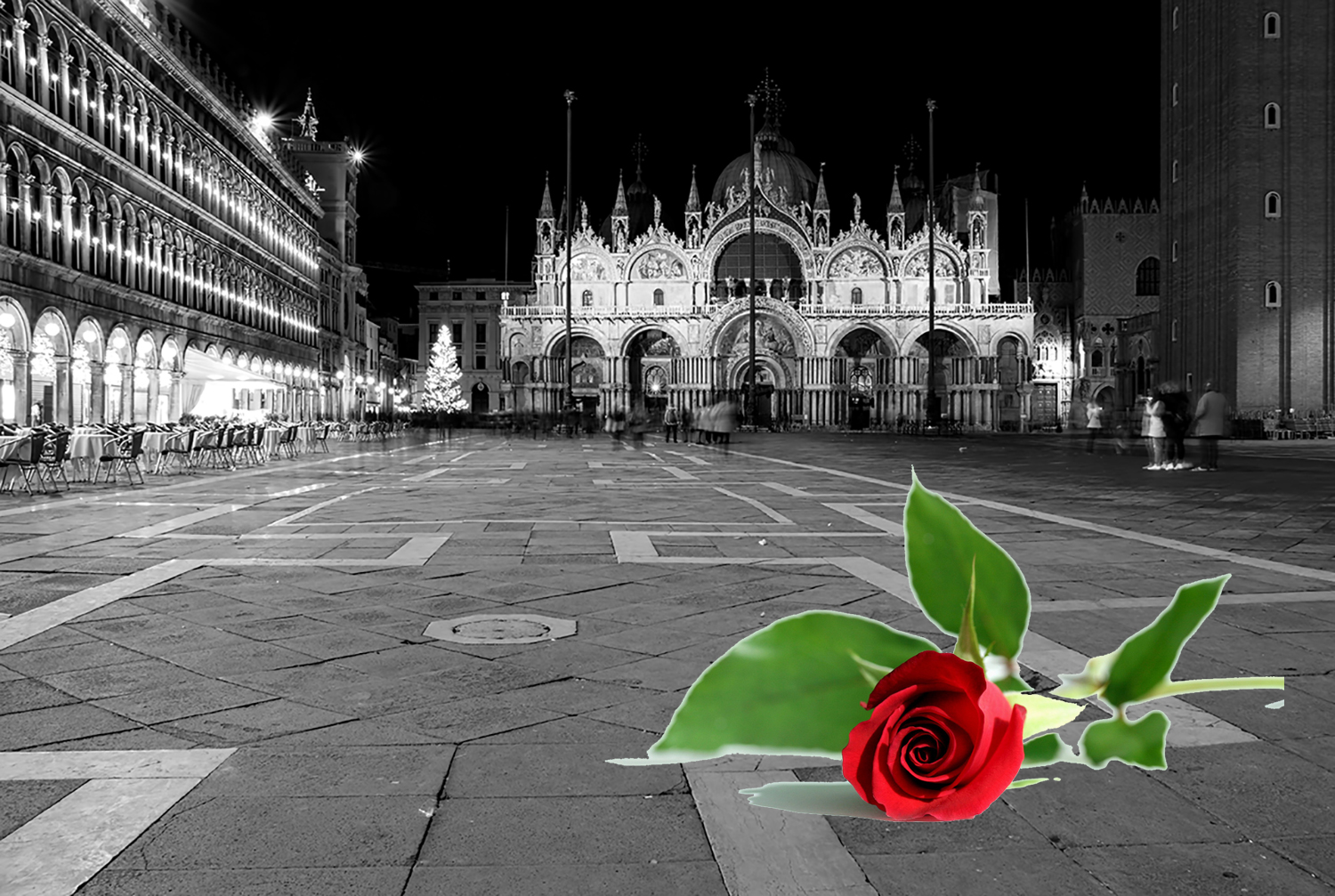
On April 25th in Venice, it is customary to give the bocolo (a red rose bud) to your loved one. The Legend of the Red Rose is the story of a young woman named Maria who lived in the times of Charlemagne. (2 April 748 – 28 January 814)
The young woman, a noblewoman, Maria Partecipazio belonged to a powerful family, the Partecipazio family whose claim to fame included two Doges #9 and #10. Maria fell in love with Tancredi, a troubadour. Theirs was a thwarted love, because Maria’s family did not consider the young Tancredi worthy of her.
But Maria, to ensure that Tancredi acquired at least formal nobility and could propose himself as a husband, convinced him to enlist in the troops of Emperor Charlemagne and leave for the war against the Moors of Spain. Tancredi left and distinguished himself for his valor and courage, so much so that the fame of his exploits reached Venice, reassuring Maria, who was awaiting the return of her hero so that she could finally marry him.
But Tancredi, mortally wounded during the battle, died in a rose garden, dyeing it red with his blood. With his last strength he picked up a bud and entrusted it to Orlando (his companion), asking him to take it to Maria together with her last words of love. Orlando, obeying his promise, went to Venice as soon as he returned home and delivered the flower to Maria. The rose is known as “il bocolo” in Venetian.
It was St. Mark’s Day. Maria would die that same night, with the flower clutched to her chest. Even today it is said that the ghost of Mary, on the day of San Marco, April 25th, wanders around Venice, a diaphanous presence without color, if not for that red flower clutched to her chest…
The tradition continues with the men of Venice bringing a single rose to their loved one on the 25th of March (which is also the date of the birth of Venice)
The date symbolizes the laying of the first stone of the city. On that the day, according to the chronicles of the time, two Paduan consulares sanctioned the birth of Venice. From there began the construction of the church of San Giacomo, in Rivus Altus (the current Rialto).