
Just a quick update on the dates you will be required to have an access pass to enter Venice.
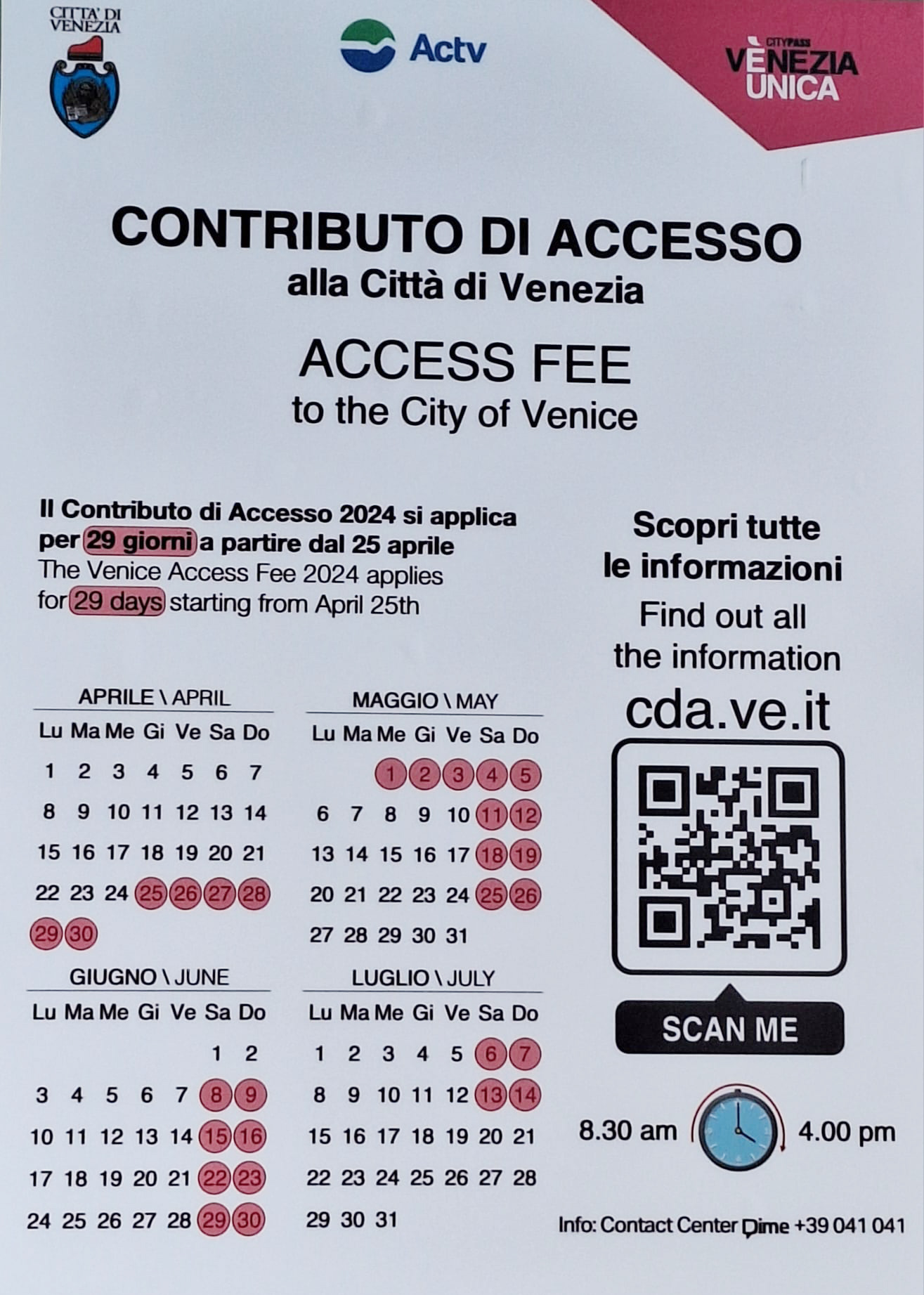
Again, if you are staying at a hotel, the hotel will arrange this. But you need to verify with them. If you are NOT staying in Venice, rather staying on another island, like Murano, Burano, Lido you will not need the access permit. You will just be transiting through your arrival point (like the train station or Piazzale Roma) so much like a connecting flight city.
If you are staying with a relative who is a Venetian (or has a resident permit) they can arrange for you.
If you are staying in an AirBnB or other private rental, best to get your information from them, have them get your permit. I have not seen specific information on these types of rentals.
The permit is an electronic QR Code which you will keep on your phone. It has not been established if there will be mandatory scanning at points of entry or if it will be random, much like the people of the vaporetto sometimes scan your vaporetto ticket.
You may also check the website https://cda.ve.it/ for information. It is available in English, French, German, Italian, and Spanish. Even if someone else will be obtaining for you, I advise that you take a look at the website, wouldn’t want your once-in-a-lifetime trip to Venice to end before it begins. And be sure you load the code on your phone before you leave home, not taking the chance that you won’t have decent wifi along the way.
Much has been written/said about charging a fee for entrance. Enjoy this short story on one of the possible outcomes of the fee. Personally I think it should be more than 5 Euro just to offset the cost of cleaning the streets daily, emptying the trash cans (or picking up the trash people throw at or near the cans). It certainly does not pay for the wear and tear on this beautiful old city.
Story about the impact on Venice of charging an entrance fee (completely fictional).
In the heart of Venice, where the canals weave their way like veins through ancient stone, a decision was made that would ripple through the city’s history. For centuries, Venice had stood as a beacon of beauty and culture, drawing travelers from across the globe to wander its labyrinthine streets and glide along its romantic waterways. But as the crowds grew thicker and the strains on the city’s infrastructure became more apparent, the Venetian authorities faced a dilemma.
“It’s simply unsustainable. The throngs of tourists, the wear and tear on our historic buildings, the strain on our resources—it cannot continue unchecked.”
After much debate, it was decided: Venice would begin charging a fee for entry into the city. A toll, like the ancient gatekeepers of old, to regulate the flow of visitors and ensure the preservation of this jewel of the Adriatic.
The announcement sent shockwaves through the travel world. Some decried it as an affront to the spirit of Venice, a betrayal of its status as a city for all. Others saw it as a necessary measure to protect the delicate balance between preservation and progress.
As the first day of the new policy dawned, tourists gathered at the edges of the city, unsure of what to expect. A line had formed at the gates, where officials stood ready to collect the newly implemented fee.
A young couple from America approached, their eyes wide with anticipation. “5 euros per person,” the gatekeeper said, holding out his hand expectantly. With a sigh, the couple handed over the money, the clink of coins echoing in the morning air.
But as they stepped through the gates and into the heart of Venice, something remarkable happened. The streets were quieter, the canals less crowded. Without the overwhelming crush of tourists, the city seemed to breathe a sigh of relief.
As the days turned into weeks and the weeks into months, Venice began to transform. With fewer visitors, locals reclaimed their city, rediscovering the joys of quiet evenings and leisurely strolls along the canals. The historic buildings, freed from the constant onslaught of foot traffic, began to gleam once more in the Venetian sun.
And yet, despite the initial outcry, a strange thing began to happen. As word spread of Venice’s new approach, travelers from around the world began to see the city in a new light. No longer a mere stop on a whirlwind tour of Europe, Venice became a destination unto itself, a place worth savoring rather than rushing through.