

The exhibition “Monet and Venice” at the de Young Museum is a major international showcase devoted to Claude Monet’s luminous and atmospheric paintings of Venice, created during his only visit to the city in 1908. Bringing together more than 100 works, including over 20 of his Venetian canvases, the exhibition places these paintings within the broader arc of his career, alongside earlier works and later masterpieces such as his iconic water lilies of Giverny. It is the first exhibition in over a century dedicated specifically to Monet’s Venice series, highlighting how this brief but transformative trip reshaped his artistic vision.
What makes the exhibition especially compelling is its exploration of how Monet interpreted Venice—not as a bustling city, but as a quiet, almost dreamlike place where architecture dissolves into light and color. Painted often from a gondola, his views of landmarks like the Grand Canal and the Doge’s Palace emphasize shifting reflections, atmosphere, and fleeting moments rather than precise detail. The show also situates Monet within a larger artistic tradition, presenting works by other artists who painted Venice, and concludes by demonstrating how the experience reinvigorated his later work, particularly the water lilies. The result is an immersive journey into Monet’s evolving perception of light, water, and beauty at the height of his career.
Alongside the shimmering color of Monet and Venice, the exhibition introduces a striking counterpoint: monumental black-and-white photographs that immerse visitors in the Venice Monet. These large-scale images—many enlarged far beyond their original size—strip the city down to its essential forms: arches, facades, waterways, and reflections rendered in stark tonal contrast. Without color, the viewer becomes acutely aware of structure, light, and shadow, echoing the very elements Monet was chasing in paint. The dramatic scale of these photographs transforms them from simple documentation into an almost architectural presence, surrounding the viewer and placing them inside the visual world of early 20th-century Venice.
What makes these photographs especially compelling is how they deepen the understanding of Monet’s work. By presenting Venice in monochrome, they reveal the underlying geometry and atmospheric conditions that Monet translated into color and brushstroke. In many ways, they act as a visual bridge—showing the “reality” of Venice while highlighting just how radically Monet reinterpreted it. The contrast between the crisp photographic detail and Monet’s dissolving, luminous surfaces underscores his genius: he was not recording Venice, but transforming it into a meditation on light, time, and perception.
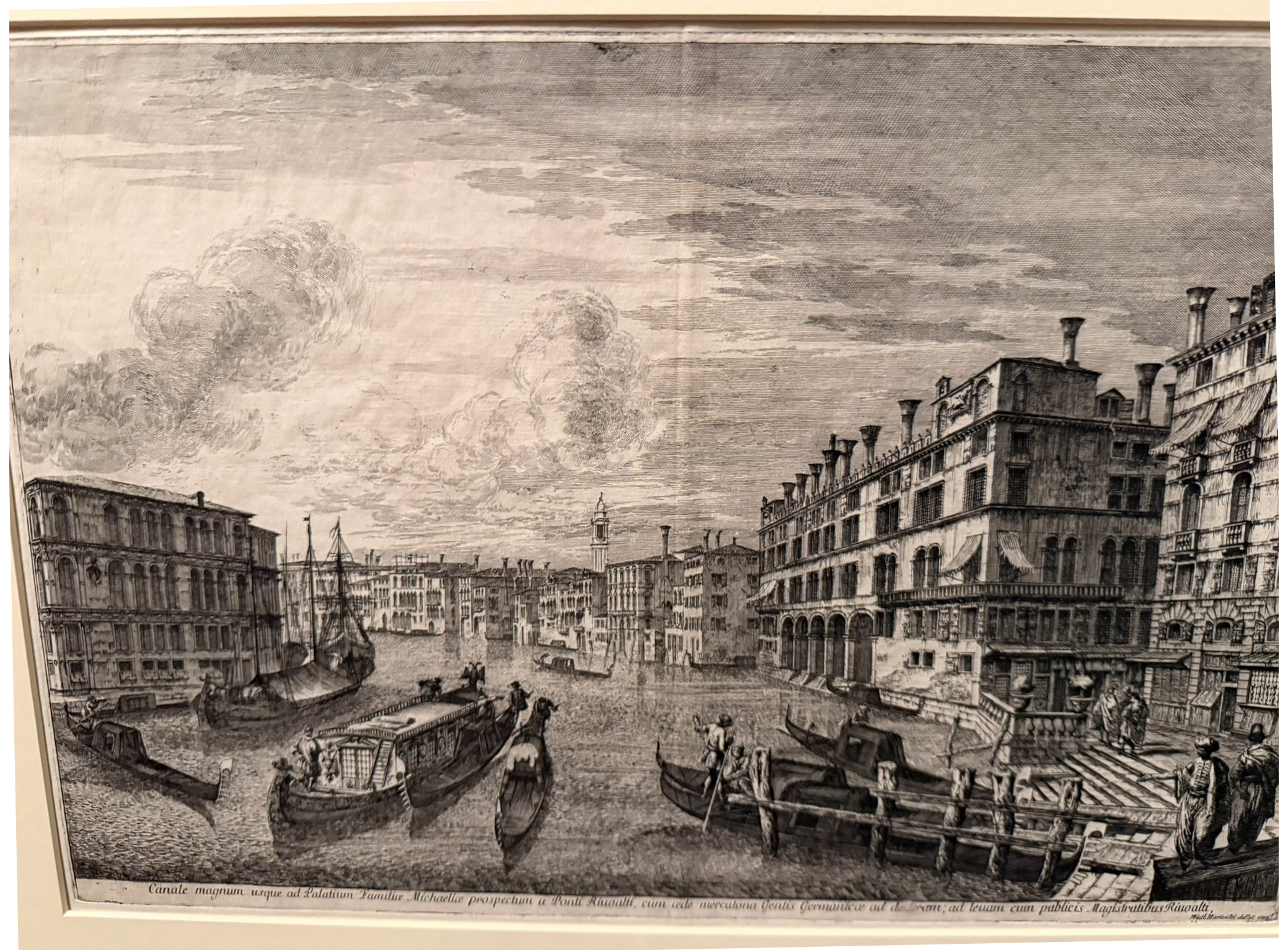
In Monet and Venice, Monet’s paintings are placed in dialogue with a rich lineage of artists who were equally captivated by Venice. The exhibition includes works by earlier masters such as Canaletto and Francesco Guardi, whose precise vedute (city views) defined Venice in the 18th century. Their detailed architectural renderings provide a fascinating contrast to Monet’s softer, more atmospheric interpretations.
The show also features later artists who, like Monet, explored mood and light over strict realism. These include J. M. W. Turner, whose luminous, almost abstract visions of Venice prefigure Impressionism, and John Singer Sargent, known for his fluid, light-filled Venetian scenes. Together, these artists create a broader narrative—showing how Venice has continuously inspired painters to reinterpret the city through their own evolving styles, with Monet’s work representing a turning point toward modern, perception-driven art.
Black and White Video
Within Monet and Venice, the inclusion of black-and-white film introduces yet another dimension to the experience—one that feels surprisingly modern despite its historical roots. It gives you an idea of how Venice was during this period. The footage, often shown at a large scale, captures everyday life in Venice, particularly scenes of crowds moving through Piazza San Marco. Visitors drift across the square, pigeons scatter, and the rhythms of daily life unfold in a continuous flow. Unlike the still photographs, the moving image brings time into the equation, allowing viewers to witness Venice as a living, breathing place rather than a static subject.
Below Palazzo Dario along the Grand Canal shown in his pallet of pastels. It is just as enchanting today as it was then.

What makes these films so powerful is how it bridges past and present while expanding the exhibition beyond painting. As an early visual medium, black-and-white cinema emphasizes motion, gesture, and human presence—elements largely absent from Monet’s quiet, almost emptied scenes. The contrast is striking: where Monet dissolves the city into light and atmosphere, the film grounds it in reality, full of energy and human activity. Seen together, they reveal two truths at once—Venice as it was experienced moment by moment, and Venice as it was transformed through the artist’s eye into something timeless and poetic.
After his 1908 trip to Venice, Claude Monet spoke with unusual intensity about the experience—and it clearly shifted how he felt about his own work. In letters to his wife and friends, he admitted that Venice overwhelmed him at first, even making him hesitate to paint because of its beauty. But once he began, he became deeply absorbed, later describing the Venetian canvases as something special among his works. He delayed exhibiting them for several years, refining them back in his studio at Giverny, which suggests how important he considered them.
Most tellingly, Monet suggested that what he achieved in Venice surpassed much of what he had done before. He referred to the series as capturing effects of light and atmosphere unlike anything he had previously painted, and he treated them as a culmination rather than just another subject. In essence, Venice reawakened his artistic vision—leading him to see his earlier work as less complete in comparison to the new possibilities he discovered there, particularly in the way form could dissolve entirely into light, color, and reflection.
2 comments for “Discover Monet’s Masterpieces in Venice”